Large-capacity container stores seed and provides a steady supply for field planting.
 Multi-row planter covering broad farmland efficiently behind a working tractor.


Field Preparation and Farm Maintenance with Corn recorder
Corn recorder is suited to farms, orchards, nurseries and seasonal land-maintenance work. It supports field tasks such as tillage, mowing, spraying, handling or harvesting under local crop and terrain conditions. Before deployment, confirm working width, power, terrain, crop type, capacity, attachment interface and operator method.
 Precision planter placing corn seeds evenly across freshly prepared field rows.
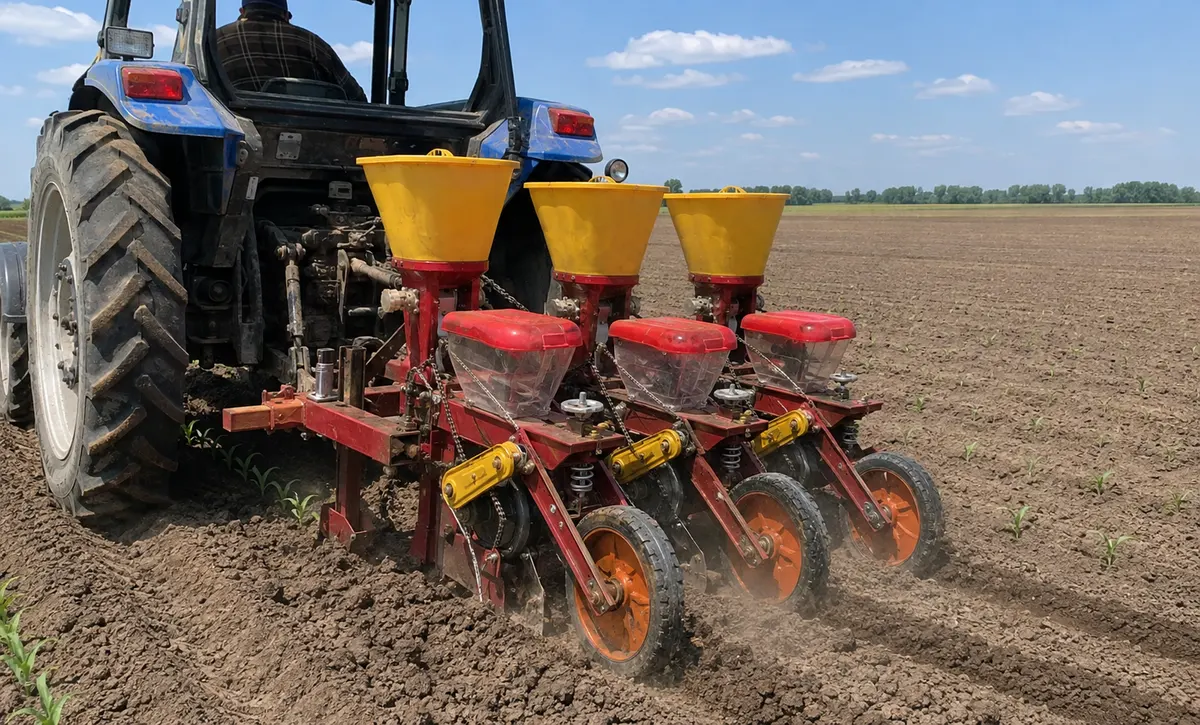 Row planter working through dry soil while maintaining consistent seed spacing.Multi-row planter covering broad farmland efficiently behind a working tractor.
 Tractor-mounted planter creating straight, uniform rows across an open field.Precision planter placing corn seeds evenly across freshly prepared field rows.Row planter working through dry soil while maintaining consistent seed spacing.

Large-capacity container stores seed and provides a steady supply for field planting.
Rotary metering component controls seed delivery for consistent planting intervals.
Compact material bin supplies seed or fertilizer to the individual planting row.
Reinforced curved mount secures the hopper firmly to the main toolbar frame.
Heavy-duty ground tool penetrates soil and prepares a stable planting furrow.
Height-adjustable shank and blade open the soil accurately at the required depth.
Bearing and axle hardware support smooth wheel rotation during field operation.
Our team is ready to advise you on the best product configuration and procurement plan.
info@eascoutia.com400 158 58991. It is commonly used for farms, orchards, nurseries and seasonal land-maintenance work, subject to the selected model and site conditions.
2. Match working width, power, terrain, crop type, capacity, attachment interface and operator method to the actual workload and operating environment.
3. Confirm model, power, working attachment, tire or track type and optional implements, then verify the response time and any special requirements.
4. Prepare appropriate fuel or charging support, safe attachment setup and pre-work inspection on level ground; follow the manual for operation, inspection and routine maintenance.

 Simplified explanation