Used for content input, parameter configuration, and viewing the operating status.
 Packaging Equipment Labeling


Workshop Processing and Production-Line Use with 120 x 40 mm portable metal marking machine
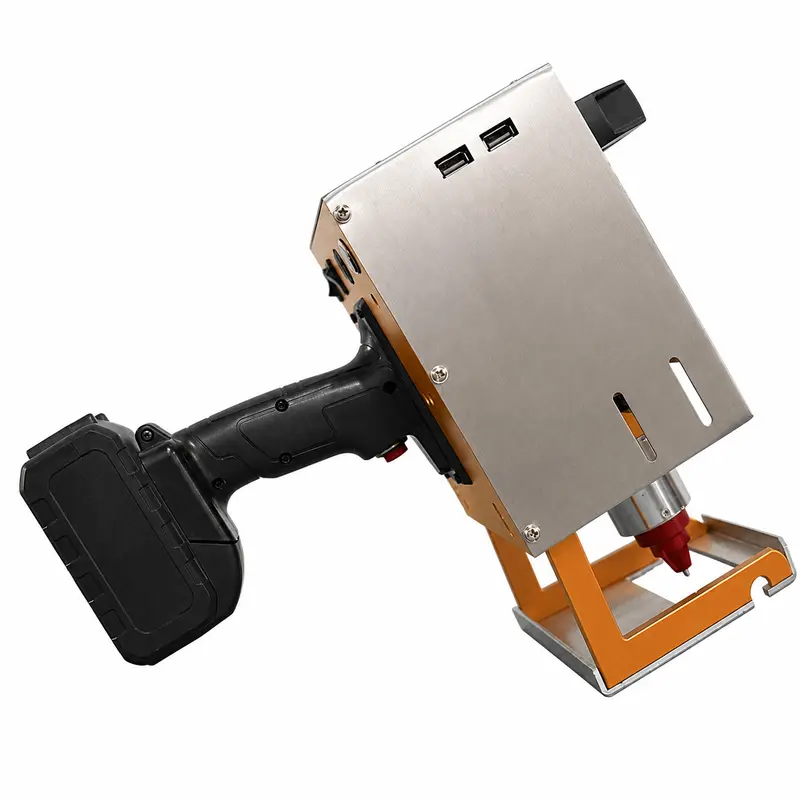
120 x 40 mm portable metal marking machine is suited to factories, fabrication shops, production cells and custom-processing workshops. It supports repeatable cutting, forming, marking, sealing, conveying or processing with defined materials and throughput. Before deployment, confirm material type, work size, capacity, accuracy, speed, control method, power and extraction needs.
 Metal nameplate engraving
 Batch part marking
 Large panel markingPackaging Equipment Labeling
 Industrial information engravingMetal nameplate engravingBatch part marking
You can access the marking software by tapping on the touch screen, and function entries are displayed centrally as icons.

Used for content input, parameter configuration, and viewing the operating status.
It undertakes the functions of equipment logic control and signal processing.
Provides drive control for internal motion actuator components.
Balances handheld operation with mobile power supply, facilitating on-site work.
Provides stable linear motion guidance for the actuator.
It undertakes the actual impact marking operations on the workpiece surface.
Providing controllable driving force for motion mechanisms.

Demonstrates the SD-4-1240 portable metal marking machine’s exterior, touch‑screen operation, and on‑site marking process.
00:14Demonstrates the SD-4-1240 portable metal marking machine’s exterior, touch‑screen operation, and on‑site marking process.
00:40Demonstrates the parameter settings of the SD-4-1240, the alignment and bonding of the positioning bracket, and the marking operation on metal workpieces.
00:12Product packaging. Professional shockproof packaging with reinforced packing for safe long-distance transportation.
05:27Laser Equipment Installation 2. Precise assembly and systematic inspection to guarantee stable operation.
Real on-site records from our factory, offering a practical view of our production capability and delivery readiness.
We centrally purchase equipment, test the data and the machine, then publish the models that clear our review. You get a shorter path from "could work" to a quote your team can act on.
Our team is ready to advise you on the best product configuration and procurement plan.
info@eascoutia.com400 158 58991. It is commonly used for factories, fabrication shops, production cells and custom-processing workshops, subject to the selected model and site conditions.
2. Match material type, work size, capacity, accuracy, speed, control method, power and extraction needs to the actual workload and operating environment.
3. Confirm model, working area, power, tooling, control system and optional fixtures, then verify the response time and any special requirements.
4. Prepare rated utilities, safe operating clearance, ventilation or dust extraction and operator training; follow the manual for operation, inspection and routine maintenance.
 Simplified explanation
